Published October 30, 2023 | Last updated September 1, 2026
Choosing an RV storage facility is not just about finding a place big enough to park your motorhome.
You are trusting that facility with something that may be worth well into six figures, and the cheapest lot is not always the best deal.
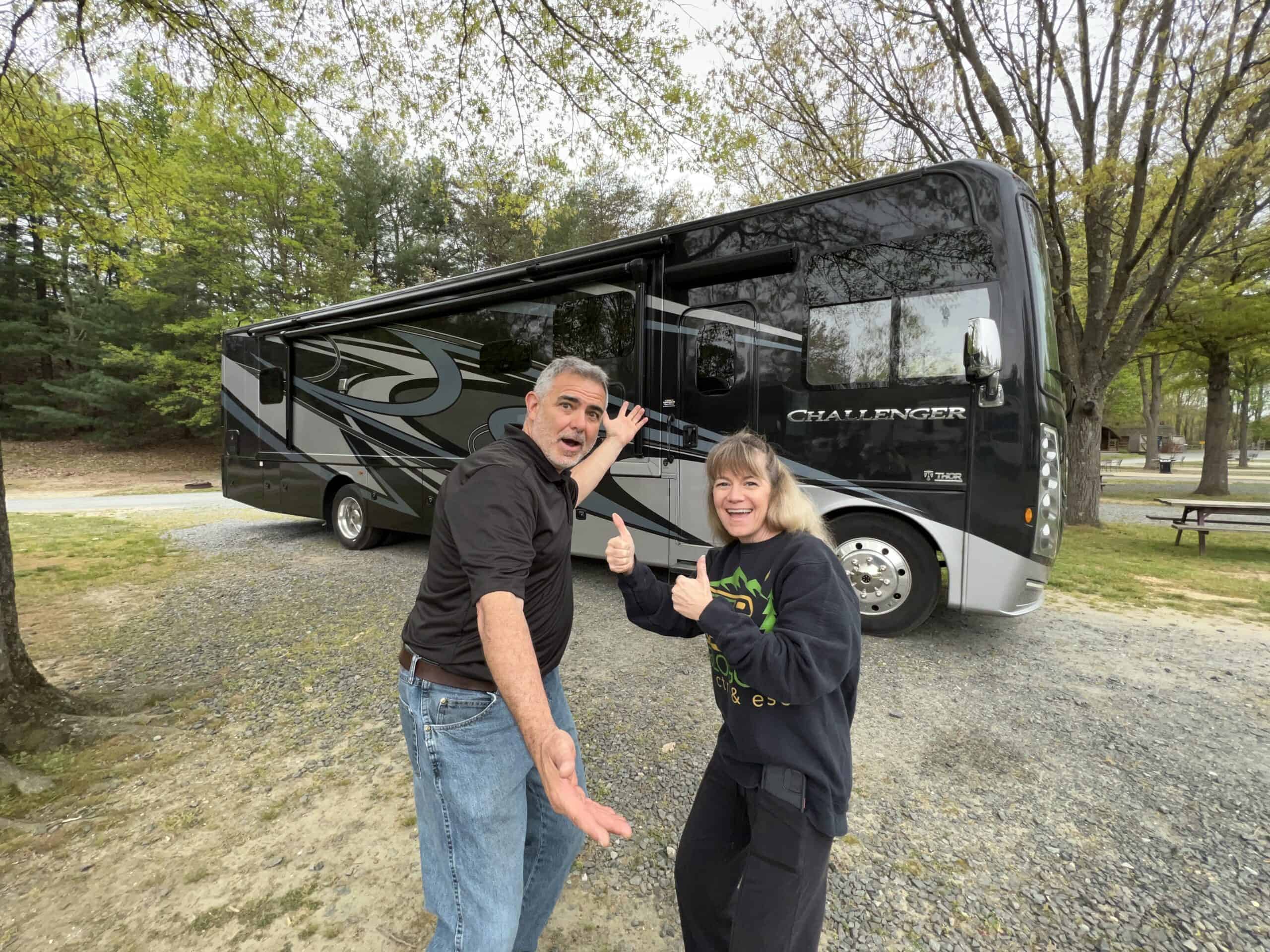
Susan and I currently use two very different storage setups for our Class A. In Maryland, we pay around $300 a month at an Extra Space Storage facility with paved parking, fencing, lighting, gated access, and security features. In Florida, we use a much less expensive HOA storage lot that is fenced and gated but has grass parking.
Neither location has power hookups.
We have also learned that even a secure storage lot cannot eliminate every risk. Someone once hit our Class A while it was parked at Extra Space Storage. The driver reported it to management, and management contacted us.
That experience changed the way I look at RV storage. Security matters, but so do management, access, lot layout, liability, and what happens after something goes wrong.
1. How Secure Is the RV Storage Facility?
Start with the obvious stuff: fencing, gates, lighting, cameras, and controlled access.
I would want a facility where random people cannot simply drive in and wander around the lot.
Ask whether each renter has an individual gate code, whether entry and exit are logged, and whether the cameras are actually recording or are just there as a deterrent.
A camera is only useful after an incident if the footage exists and management can retrieve it.
2. What Happens If Someone Damages Your RV?
This is one of the first questions I would ask because we have actually had it happen.
Someone hit our Class A while it was in storage. Fortunately, the driver reported it to the facility, and management contacted us.
That was a much better outcome than walking in days later, finding damage, and having no idea what happened.
Ask how the facility documents incidents, how they contact owners, whether they preserve camera footage, and what information they will provide if another renter damages your RV.
Also read the rental agreement closely. Do not assume the storage company is financially responsible for theft, collision damage, storm damage, or vandalism just because your RV is behind their gate.
3. Does Your RV Insurance Cover It While in Storage?
I would verify this with your insurance company before signing a storage contract.
Ask specifically about theft, vandalism, weather damage, falling objects, fire, and another vehicle hitting the RV while it is parked.
The storage facility’s contract may place most of that responsibility back on you.
4. Is the Parking Surface Paved, Gravel, or Grass?
This matters more than people think.
Our Maryland storage is paved. Our Florida HOA storage is on grass.
Grass can be cheaper, but I would pay close attention to drainage, soft ground, standing water, mud, and how difficult it could become to move a heavy motorhome after a lot of rain.
With a large Class A, I also want the surface reasonably level so the RV is not sitting twisted or leaning badly for months.
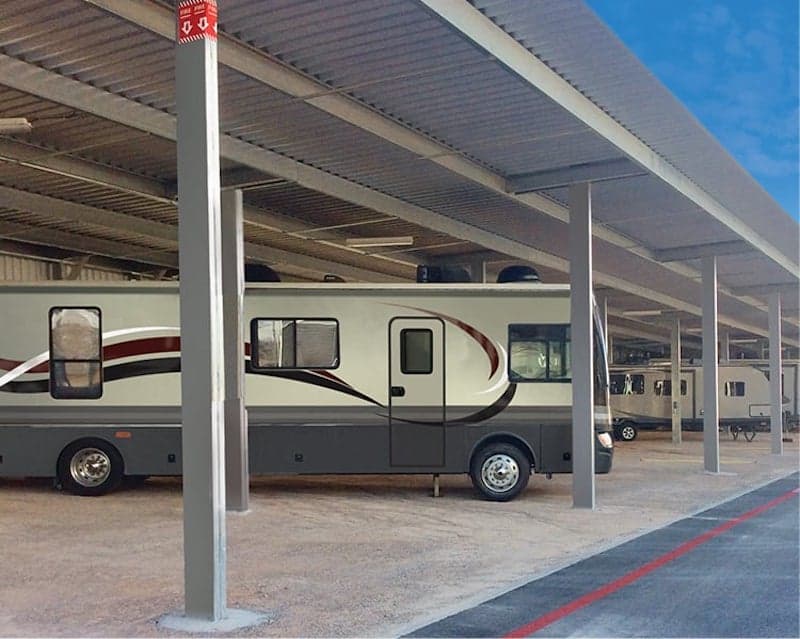
5. Is There Enough Room to Maneuver a Large Motorhome?
Do not judge the facility only by the size of the parking space.
Look at the drive aisles, turns, gate width, parked vehicles across from your spot, low tree branches, poles, curbs, and anything else that can make getting a long motorhome in and out difficult.
A 40-foot parking space does not help much if you cannot swing the RV into it without three people spotting you.
If possible, visit in person before you sign up and imagine making the turn with your actual RV.
6. What Are the Access Hours?
This can become annoying fast if you like leaving early for a trip or arriving home late.
Ask when the gate opens, when it locks, and whether after-hours access is possible.
I would also ask what happens if the gate system fails. Is there an emergency number? Is someone nearby who can let you in?
7. Is Electricity Available?
Neither of our current storage locations has power available.
If you want to keep your RV plugged in, maintain batteries with the converter, run a dehumidifier, or use any other electrical equipment, ask before you rent the space.
Do not assume that seeing outlets around the property means renters are allowed to use them.
If power is included, ask what voltage and amperage are available, whether it is individually metered, and whether there is an extra charge.
8. Are Water, Dumping, Washing, or Maintenance Allowed?
Some RV storage facilities are basically parking lots. Others offer water, dump stations, wash areas, air compressors, or small maintenance areas.
Ask what you are actually allowed to do at your space.
Can you winterize there? Can you wash the RV? Can a mobile RV technician work on it? Can you change batteries or do minor repairs?
Those rules can matter a lot if you do not have room to work on the RV at home.
9. How Well Does the Lot Drain?
I would pay particular attention to this with outdoor storage.
Look for low spots, standing water, erosion, mud, or evidence that water runs toward the parking spaces during heavy rain.
In areas that can flood, ask whether the property has ever had water on the lot and how high it got.
A fenced lot is not much protection if your RV ends up sitting in floodwater.
10. What Do They Do About Pests and Vegetation?
Grass, weeds, trees, and nearby brush can create their own problems.
I would ask how often the lot is mowed, whether tree limbs are trimmed, and whether the facility does anything to control rodents.
Even if the facility does pest control, I would still prepare the RV for storage myself. A mouse can do a surprising amount of damage to wiring and upholstery.
11. What Does the Storage Contract Really Say?
Read the contract before you hand over your credit card.
Look for automatic price increases, required insurance, late fees, notice requirements, limits on access, prohibited repairs, liability waivers, and what happens if the facility needs you to move the RV.
I would also ask how often rates can change.
A cheap introductory rate is less impressive if it jumps a few months later.
12. Is the Location Convenient Enough That You Will Actually Use the RV?
This one sounds less important than security, but it matters.
If the storage facility is 45 minutes in the wrong direction, every trip starts and ends with an extra headache.
You may also need to visit the RV between trips to check batteries, tires, roof leaks, pests, or just pick something up.
For me, I would rather pay a little more for a facility I can get to easily than save money on a spot that becomes a chore every time I need the RV.
Covered vs. Outdoor RV Storage
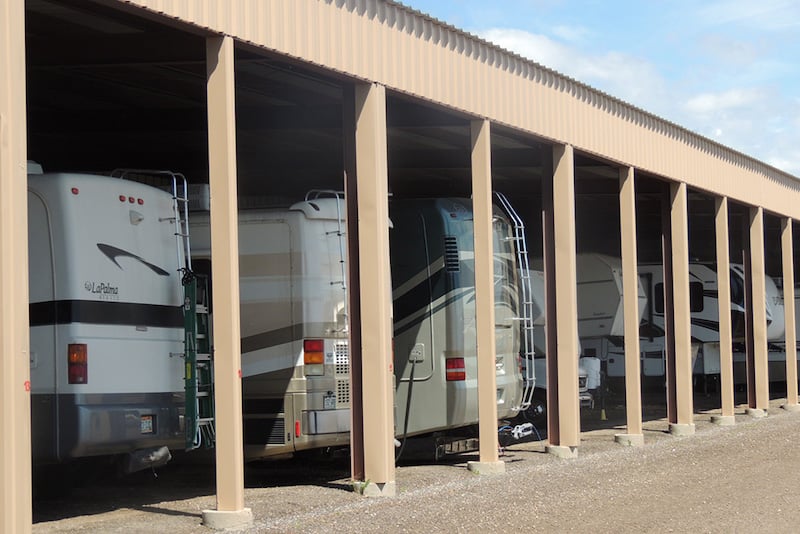
Covered or indoor storage can protect the roof, paint, seals, tires, and interior from sun, hail, snow, and tree debris, but it usually costs more and may have limited availability for large motorhomes.
Outdoor storage is usually cheaper and easier to find.
We currently use outdoor storage in both Maryland and Florida, so I do not think covered storage is mandatory. But if I had two facilities that were otherwise equal and covered storage fit the budget, I would consider it a real advantage.
Can You Store a Motorhome at Home Instead?
If you have the space and local rules allow it, home storage can be much more convenient.
But local zoning, HOA rules, driveway size, slope, visibility, and neighborhood restrictions can make that impossible.
We have a separate article on whether you can park a motorhome in your driveway.
My Bottom Line
The best RV storage facility is not automatically the cheapest or the one with the fanciest gate.
Our two storage setups prove that. We pay around $300 a month for paved, more secure storage in Maryland and much less for a fenced HOA grass lot in Florida. Both work for us, but for different reasons.
What I care about most is whether the RV is reasonably secure, whether I can maneuver in and out without damaging it, whether the property drains well, whether management responds when something goes wrong, and whether the contract leaves me with any surprises.
Visit the facility before you sign. Walk the lot. Look at the other RVs. Look at the gate, cameras, pavement, grass, drainage, trees, and turning room.
Then read the contract.
A little extra homework up front is a lot easier than dealing with a damaged motorhome later.
Related Reading
Can You Park a Motorhome in Your Driveway?
Cat Strap: RV Catalytic Converter Theft Prevention
How to Secure an RV During a Hurricane
About the Author:

Hi, I’m Mike Scarpignato, co-founder of TravelTrailerPro.com, RVBlogger.com, and MotorhomeFAQs.com and the RVBlogger YouTube Channel.
My wife, Susan, and I have been creating RV content since 2018. We travel the country visiting RV shows, touring dealerships, reviewing campers, testing gear, and spending plenty of time camping in our motorhome. Most of what we share comes from actually using RVs, making mistakes, fixing problems, and learning what works in the real world.
Susan is usually behind the camera on our RVBlogger YouTube channel, which has more than 215,000 subscribers. We also run RV Camping for Newbies, a private Facebook group with more than 275,000 members, and publish four weekly RV newsletters reaching more than 85,000 subscribers.
Our goal is simple: help beginners and experienced RVers choose the right RV, avoid expensive mistakes, and enjoy the RV lifestyle with a little less frustration.